


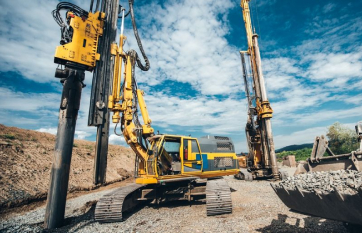
In carrying out drilling work, especially geotechnical drilling, several key aspects must be taken into consideration, including:
1. Lokasi Titik Bor
The drilling locations are determined after assessing the length of the landslide area and are applied in accordance with SNI standards. For small landslides (less than 150 m), three drilling locations are required, while for larger landslides, the number of boreholes is adjusted based on technical needs.
The borehole locations are set in the field with planned depths, referring to the engineering requirements in accordance with SNI-8460-2017: Geotechnical Design Requirements.
2. Kedalaman Akhir Pengeboran
The final depth of the completed borehole must comply with the applied technical specifications. Verification is done by inserting the drill rod until it reaches the bottom of the borehole or by another method approved by the Supervising Engineer, with execution conducted under supervision.
3. Pengambilan Contoh Pengeborna (Core Sample)
The target for core recovery percentage for each sample is 100%. In the event of poor recovery, a report must be submitted immediately.
4. Pencatatan Tinggi Muka Iar Tanah
Groundwater level measurements are taken twice: The first measurement at the start of drilling and the second measurement after drilling is completed.
5. Kotak Pencontohan (Corebox)
The core box is made from planed and painted hardwood equivalent to Borneo wood, equipped with a hinged cover and a lock point (padlock). Each box has a capacity of 5 meters of depth, divided into 5 channels @ 1 meter depth.
6. Pemberian Label Contoh (Sample)
Each storage box is labeled or tagged. The information included on the label consists of:
· Nama/lokasi proyek.
· Nomor titik bor.
· Nomor (urut) kotak penyimpanan.
· Kisaran kedalaman.
· Nama Pelaksana Pekerjaan.
Labels must be written using black paint on the outer lid, inner lid, and the front side of the box. The core boxes must be stored in a dry location, protected from water and direct sunlight. The storage location for all core boxes will be further determined by the Project Director.
7. Peralatan Kerja Pengeboran
a. Drive hammer Assembly
i. Hammer weighing 63.5 kg.
ii. Guide pipe of sufficient length to allow the hammer to fall freely at a height of 75 cm.
iii. Topi pelindung (knocking head) dan kabel baja / slin
b. Stang Bor / Rod.
Diameter must match the borehole or the type of drilling machine used.
c. Split Spoon Sampler Barrel.
Outer diameter: 2 inches, inner diameter: 1 3/8 inches.
Others
Material seperti pelumas, parafin, kantong plastik dan lain-lain, disediakan dengan cukup, mengingat lokasinya yang terpencil.
8. Metode Pengujian Secara Umum
· Setelah pemboran mencapai kedalaman yang direncanakan lubang bor dibersihkan hingga ke dasarnya dengan mata bor dan alat-alat lain untuk menjamin yang akan diuji tidak terganggu.
· Split Spoon Sampler Barrel (yang bersih dan sedikit dilumasi oli) dipasang pada bagian ujung stang bor. Semua sambungan dipasang dengan kuat sehingga tidak lepas sewaktu berlangsungnya pelaksanaan pekerjaan. Spoon diturunkan ke dasar lobang pemboran dan topi pelindung pemandu dipasang dibagian atas stang bor.
· Kemudian palu dijatuhkan pada topi pelindung dari ketinggian 75 cm. Untuk pancangan posisi awal, split spoon dimasukkan sedalam 15 cm. Jumlah pukulan / tumbukan yang diperlukan dicatat (N1)
· Setelah itu, dimulai pancangan uji (drive testing) dengan prosedur butir-3, hingga split spoon masuk sedalam 30 cm, pencatatan jumlah pukulan dalam 2 tahap. Tahap-1 adalah pukulan untuk masuk sedalam 15 cm berikutnya (N3) jadi, Harga N = N2 + N3
· Apabila harga N nilainya lebih besar dari 60 pukulan. Pengujian dihentikan.
· Konsultan membuat pelindung / tenda pada lokasi pengujian / pemboran dalam hal tak terjaminnya pelaksanaan pekerjaan disebabkan oleh hujan dan penyebab lain.
Lima Manfaat Survey Pendahuluan
Mekanisme Pengambilan Data Geolistrik
Fundamentals of Geoelectrical Acquisition
Methodology of Full Core Drilling in Geotechnical Engineering

